🧵 View Thread
🧵 Thread (148 tweets)

serious question. is procrastination real? or are you doing exactly what you want in every instant and too ashamed to admit it?
@visakanv @ChrisChipMonk Oh right https://t.co/Y21ZPUPrBO
It’s kind of funny that as you get better at noticing things, one of the harder things to notice is the difference between what you notice and what others notice. once you’ve noticed something it tends to feel “obvious” and it’s natural to assume everyone else notices it too
@endotheremin @Reverend_Bayes @ChrisChipMonk Strongly disagree. It just means that you need to figure out some interim action before adjusting diet or exercising more. You can’t jump to the second floor (where you want to go), you have to take the stairs and figure out each step
@ChrisChipMonk i believe it is the latter. if we’re avoiding something, we’re either not as interested in pursuing it at the moment (that could be due to the fact that we want to do x instead of y but we aren’t aware so we eventually end up self soothing) or our body wants to do something else.
@ChrisChipMonk Procrastination is absolutely real. The frame you're suggesting is incredibly dangerous. I got right to the edge of suicide thinking like that until I got my ADHD diagnosis and started taking Ritalin. Procrastination is often a matter of capacity, not wanting.
@ChrisChipMonk You can reframe anything as a "want" ofc, but that makes the world meaningless. I didn't "want" to do the thing because I already knew I wasn't in a condition to make progress. The alternative was sitting and staring at the thing for hours and making zero progress.
joanna and i discuss Flow (the antidote to Procrastination) for the first 5-10 minutes of this recording: https://t.co/HOgfnoI52e
I think the idea of impulsive vs planned desires is pretty well documented and easy to observe. Unless you’re talking about a subconscious desire to self-sabotage which is definitely something people have to examine. Instead of asking “why do I procrastinate?” And blaming external stimulus, it’s helpful to to ask “why do I WANT to procrastinate” which can help you reflect on how serious your own goals are.
@ChrisChipMonk I guess procrastination is more where we recognise that some of our habitual desires don’t match up to our consciously held aspirational expectations values. And a desire to bring more alignment between our behaviour and the values we aspire towards
for more context on this, joanna and i discuss this wrt Flow (the antidote to Procrastination) for 5 min: https://t.co/HOgfnoHxcG https://t.co/2Q6XBy6pAS
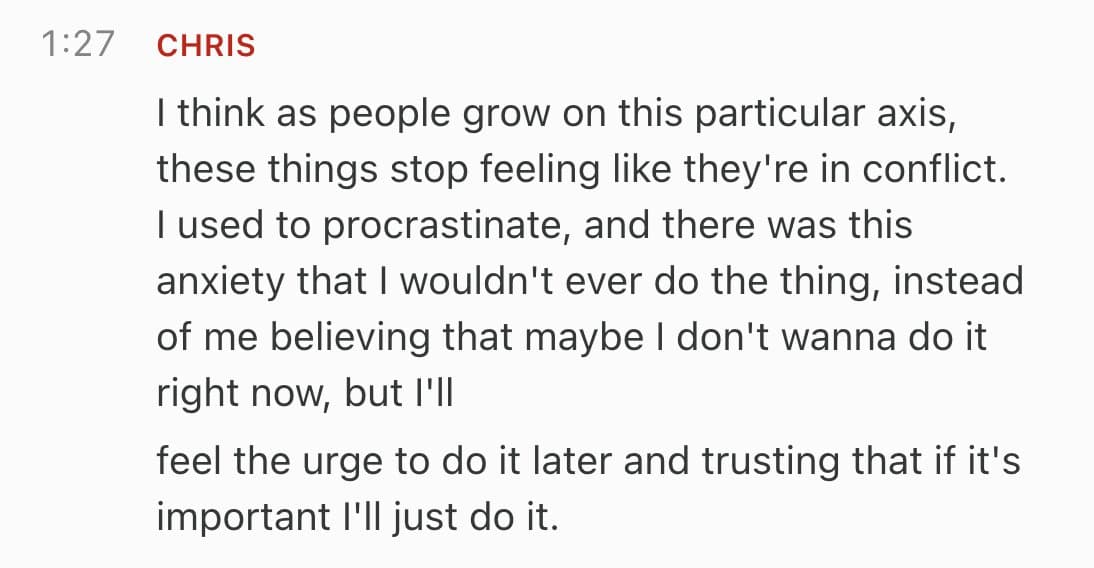
@jakozloski i don't believe this a real tradeoff -- people do long-term things that benefit them all the time. i discuss this some here https://t.co/HOgfnoI52e https://t.co/9V7vEwWuLn
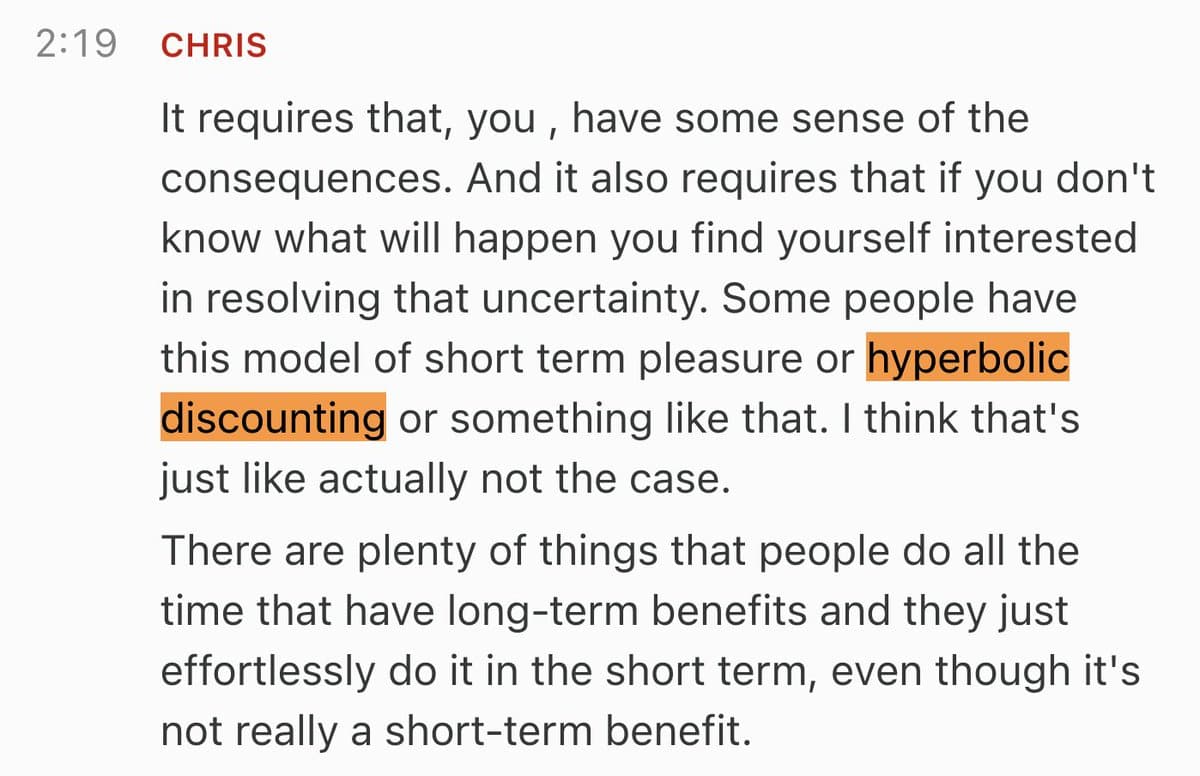
@ChrisChipMonk Right, but that feeling depends on many factors (genes, personality, stress, sleep quality). E.g. poor sleep lowers leptin and raises ghrelin, making you crave junk food. Does that mean it’s actually the right choice, even if your body strongly signals it is?
I mean your body can urge you to do things in the moment that harm your future self (e.g., intense cravings for opioids). Those feelings can strongly signal “rightness,” yet future-you might deeply regret following them. Do you disagree that your subconscious signals can sometimes be flawed, requiring conscious override through willpower? Or do you believe those signals are always correct and should always be obeyed?
@jakozloski i agree it can be flawed but only when you’re actively suppressing your feelings and intuitive signals https://t.co/OBwQY3cbWZ
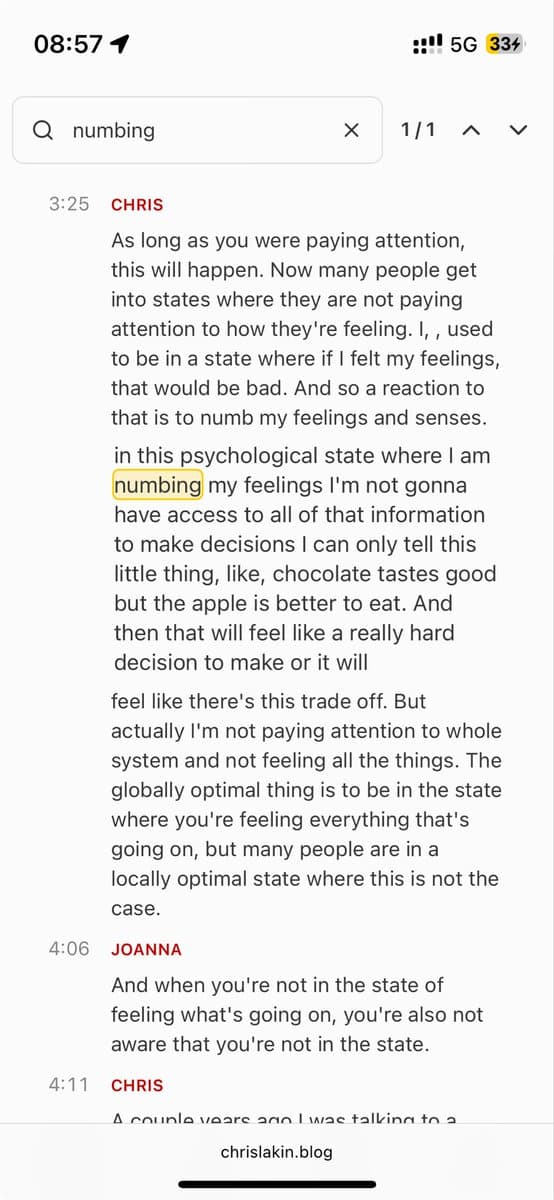
@jakozloski from https://t.co/JrIAYNAD4f
@reed_rawlings i'm not sure whims actually exist? https://t.co/HOgfnoI52e https://t.co/5fLfrUMk2i
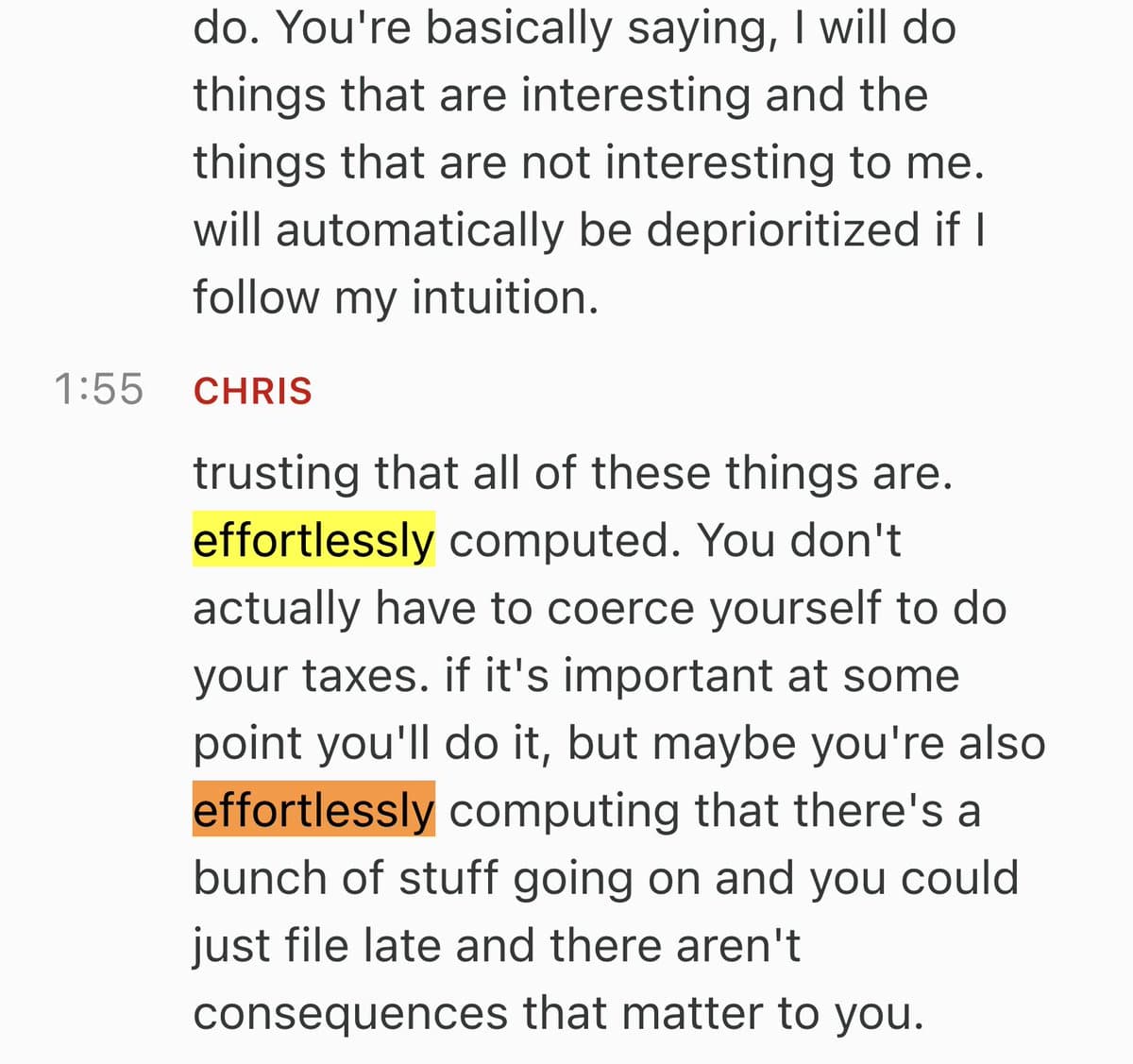
@garybasin doing whatever happens effortlessly https://t.co/SoKMomaukx https://t.co/ApwA2AUOjn
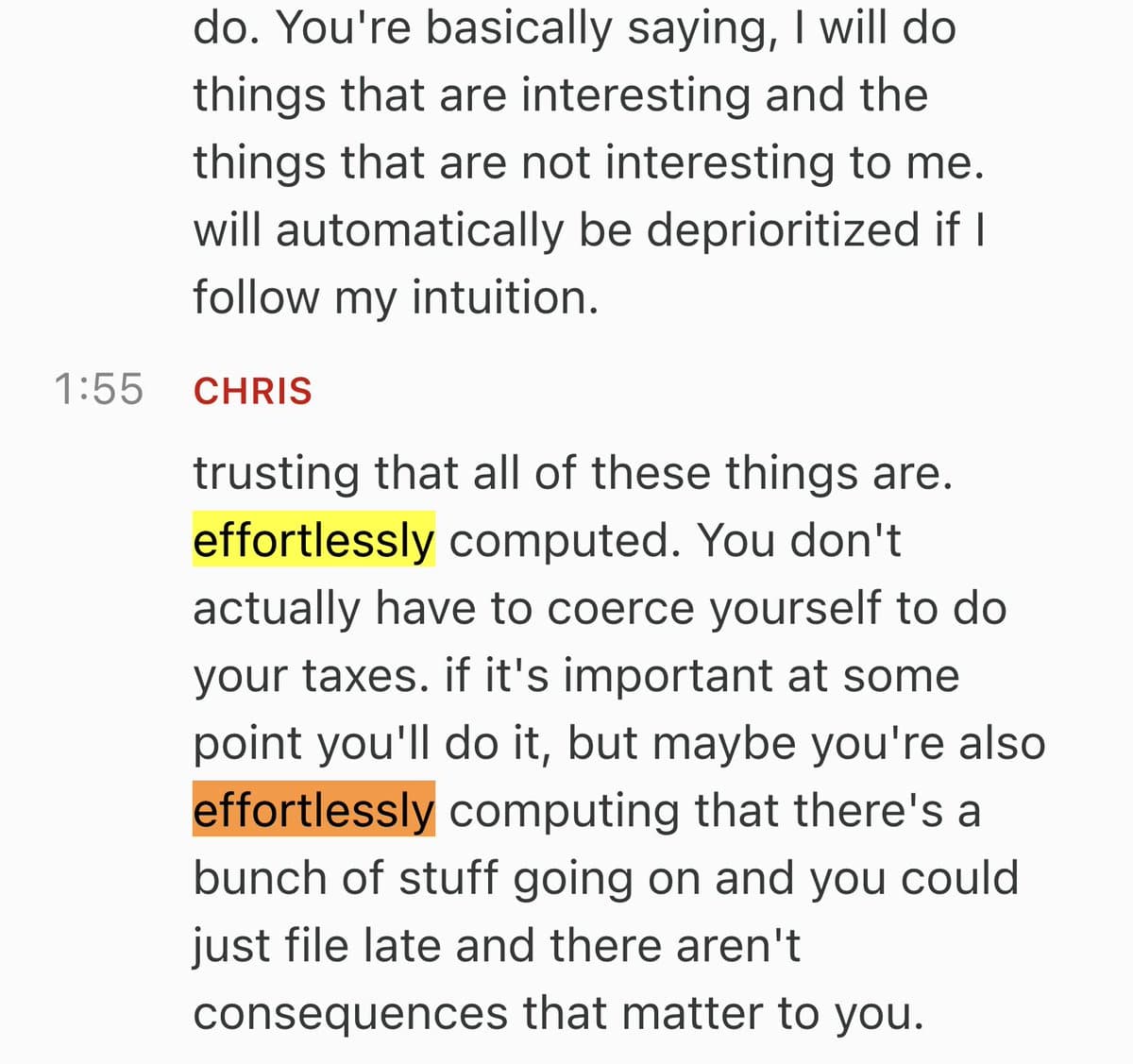
@ChrisChipMonk Serious answers. (1) People can do what they want, and do do what they want. (2) More than anything else, people want approval from other people. (3) People mainly approve things done by other people if they are potentially benefited by them themselves.
@ChrisChipMonk (3) (continued) i.e. mainly "productive" things, which when done by other people, potentially benefit them. (4) Therefore, when people want to do unproductive things, they would prefer that other people think they would like to do productive things.
@ChrisChipMonk Consequently, people do the unproductive thing that they want to do, and choose to sincerely believe that they want to do the productive thing. That way, to some extent, they can have the cake while still eating it.
“but my monkey mind can be wrong!” i agree this can happen but ONLY IF you’re numbing your feelings and intuitions & not in tune with your body. if you are, then you already have all of the information you need
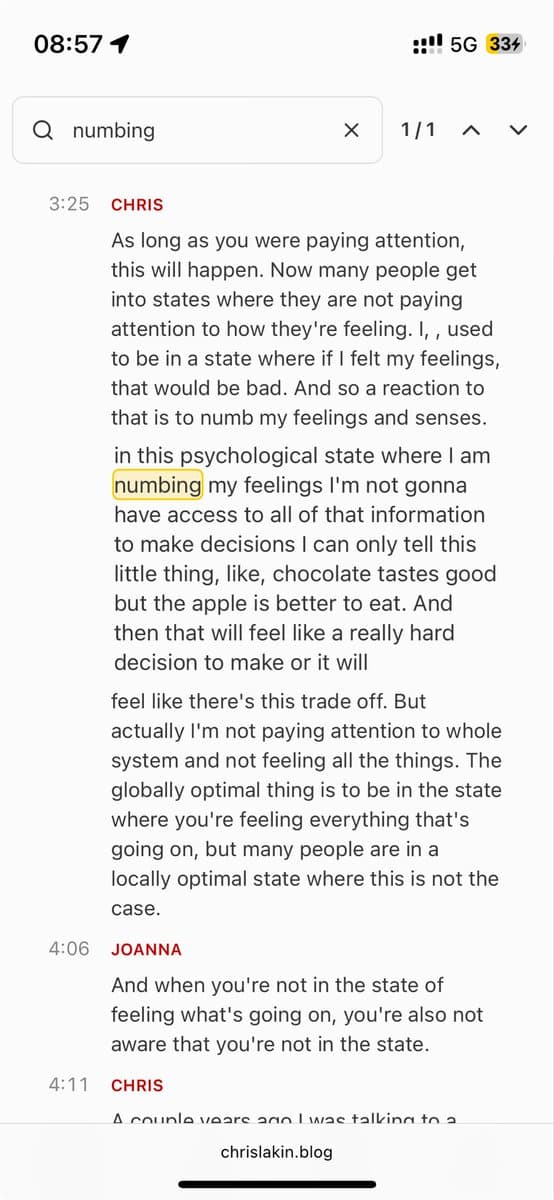
@ChrisChipMonk serious q: how would your framework explain the fact that e.g. dexamphetamine reduces procrastination? seems you would predict that it makes people stop suppressing feelings and intuitive signals, but that seems false
@rgblong haven't thought about medication much, but i've heard anecdotal reports that adhd medication numbs feelings. i think it's ALSO true (like a horseshoe) that numbing your feelings also numbs any resistance. so yea you'll do stuff--but maybe not the right stuff
@ChrisChipMonk @rgblong From my own experience (I dont have ADHD but have tried things) it feels like they work by massively contracting your attention, they make you narrowminded and that can be good. Unsure how it interacts with feelings.
@ChrisChipMonk @rgblong That seems at best incomplete; it seems some of those feelings are boosted vs other suppressed. I rather think it modulates the salience, instead of having 10 things with intensity "1", now one or two have more intensity (or the others less) and so its easier to just do things
@ChrisChipMonk I don’t think this perspective has an answer for habituation. Habitual action/attention allocation gets a prioritization bump regardless of what we want. It might be that it’s what we wanted in the past, then habituated, and no longer want. History matters.
@GarrettPetersen i’m not sure
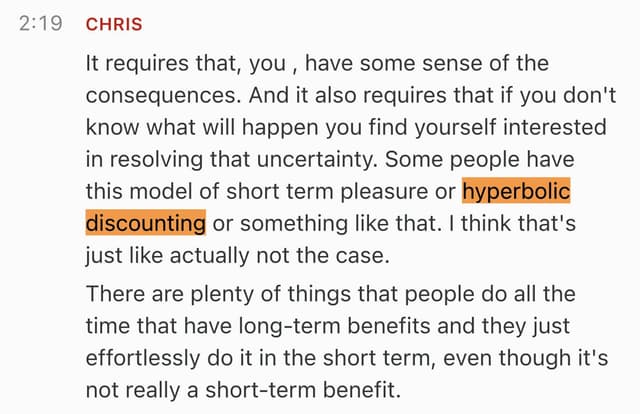
@ChrisChipMonk Short-term, local rationality beating out long term, global rationality. Same as addiction. You aren't sufficiently motivated by your future experiences to prioritize them over your present experiences for a variety of reasons like salience and time bias.
@tyler_m_john i don’t believe this! people do only long term beneficial stuff easily all the time
@ChrisChipMonk I have built my life around strategic procrastination. There's a flow that hits when you start something with the right amount of time pressure to finish before a deadline. And when there's no deadline, ive found the things i procrastinated on indefinitely had ceased to matter.
@ChrisChipMonk What is this question? How would you present arguments that procrastination is "real" or "not real"? It's referring to people choosing short term wants over long term wants, and often regretting that choice . Obviously that happens .
@cynlioness i’m not sure there’s real a short term long term tradeoff
@ChrisChipMonk no, I’ve always seen “procrastination” as just a layman’s abstraction for risk-reward calculation “how long can I put off doing [action] given that I think it’ll take [amount of time] to do, all while I do [other stuff I actually like doing]?”
@ChrisChipMonk i think this is basically correct: https://t.co/RJlEKFosPQ
As a former extreme procrastinator and a present highly productive person, yes, I like this line of questioning but I think the boring answer is correct Procrastination is a real emotional management strategy, where you’re counting on a future self to experience enough urgency to overcome whatever inertia you’re experiencing currently, and it does or doesn’t happen depending on any number of factors, mostly real consequences for not doing the thing It substitutes for the complex emotional strategies that allow you to work with anxiety in the present—it’s a crude bad solution that requires less self-honesty and nuance than learning to steer your machine well, which requires meeting yourself in all different emotional states
Btw this is why I think you will have trouble with procrastination as something to one-shot—much like a French omelette is easy to explain at a crude level but full of practical nuance, developing better strategies for your ongoing output is highly personal and context-dependent, whereas the crude strategy of “I’ll do it tomorrow” is easy to reach for
@sashachapin ohhhh thanks for addressing the one-shot thing too. yeah i’ve been understanding it as outgrowing procrastination is like learning how to feel your feelings and all of the nuance that comes with that. (meanwhile anxiety self-loathing insecurity etc is all UNLEARNING, removing)
My procrastination was mostly cured by separating planning & doing. Mindset changes: - Treat myself like an animal in a zoo where I'm both the animal and the zookeeper at different times. - Focus on environment design instead of willpower. Practical changes: - Daily reflective journaling/planning time. - Take more walks. - Timebox. - Co-work with friends. - Schedule obligations ahead of time that align with my goals.
@ChrisChipMonk https://t.co/upughQafJT
@ChrisChipMonk I remember a quote from @nntaleb stating that “procrastination is the soul rebelling against the mind.” So, yes and no? It’s a mental war between the mind (and its fears) and the heart that needs diplomacy.
I left $10k on the table once because getting it would require three steps and I was having an off day. Not wanting to do your homework is an obvious difference in preferences but I think you can semi-permanently fuck up your executive function by always doing your homework and getting nothing from it.
@ChrisChipMonk As someone who frequently experiences extended periods of doing something other than what I need to be doing, yes it is real. I often experience more anxiety from the avoidance behavior and am aware of that. But based on the comments this is a bad faith faith question so have fun
@ChrisChipMonk I think procrastination can often be the manifestation of like 5-6 different possible problems and it’s really hard to know which one. Maybe you are horrible at time management, maybe you have ADHD or are depressed. The only way to know is to identify the specific problem.
@ChrisChipMonk Fwiw, I was taking that into account. I think denying "but my monkey mind can be wrong!" arguably rules out akrasia. But neither that nor "being in tune with your body" or feelings, rules out first-order wants conflicting with what you want to want.
@ChrisChipMonk If “real” means “causing emotional misery”, then, yes, it’s definitely real. My impression is that people “procrastinate” b/c they fear, often correctly, the massively unpleasant negative feelings their own bodies generate.
the opposite of procrastination is flow btw https://t.co/KgalhC88pz
@ChrisChipMonk Serious answer. Procrastination is a sign of superior intelligence. Procrastinators know never to do today what they can put off until tomorrow because they might not have to do it. If they end up having to, they'll have found a faster, cheaper, more efficient way by then.
"Then surely, I went on, no one willingly goes after evil or what he thinks to be evil; it is not in human nature, apparently, to do so—to wish to go after what one thinks to be evil in preference to the good; and when compelled to choose one of two evils, nobody will choose the greater when he may the lesser."
@ChrisChipMonk @DrCameronMurray What do you mean by procrastination? We can feel shame and regret for conscious decisions of the past, I'd say procrastination is just a name for a common type of decision that produces these feelings.
@ChrisChipMonk "procrastination" as the label functions as an excuse or explanation for a more direct causal experience, but which is being explained using the "I procrastinate" theory. It has the same truth-value as an excuse like "I did not have enough time." - not totally but kinda false.
@ChrisChipMonk if you really drill down hard enough it looks like it's impossible to do anything that you don't "want" to do, everything you do you think is the best course of action and you justify every move, it really seems like free will isn't real.
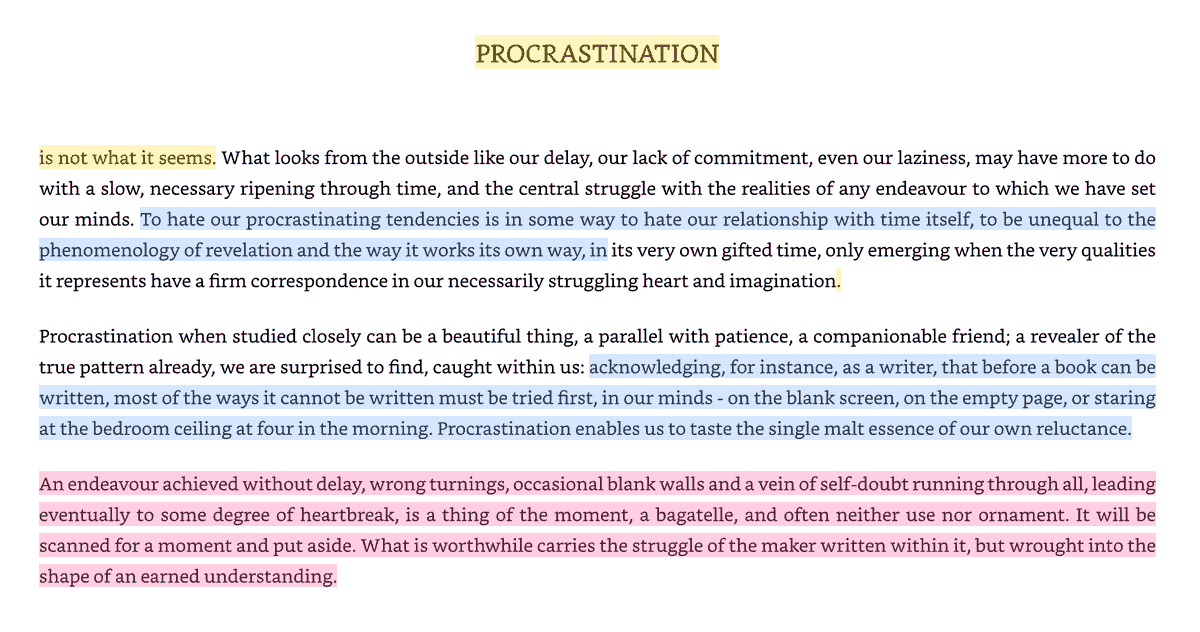
@ChrisChipMonk when this topic comes up for me I always remember David Whyte's fantastic reframing in his book "Consolations" (a book full of similar reframings, I highly recommend it) https://t.co/1Nu1NuTGX3
@ChrisChipMonk Good question! I think part of the answer is that "doing what you want" and "doing what you find easiest at any given moment" are not the same thing because humans want different (and often counterproductive) things on different time scales
@ChrisChipMonk There's a gap between what's good for us and what we want, and we have various mechanism to close that gap. When the gap is really egregious we just make it illegal, eg opium. For smaller gaps we sometimes use social expectations, eg labeling things "procrastination".
@ChrisChipMonk Uhh literally ADHD is a break between the desiring part of your brain and the actually mechanically doing stuff part of your brain. I've literally sat for hours constantly thinking about what I should be doing and not doing it.
@ChrisChipMonk https://t.co/laLR9LfEyl
@ChrisChipMonk Your body does whatever it wants all the time, always see action, not speech, behavioral analysis 101. You are not your body, you are a small voting party inside it. So yeah, procrastination always involves SOME level of denying
@ChrisChipMonk This rang true for me. But there's probably many different "generators" for procrastination. It's real in the sense that it's serving a purpose. It's just that the purpose IT is serving and the goal YOU have are incongruent. https://t.co/vI0nh3Rgdt

@ChrisChipMonk I like analogizing procrastination to a situation where you're chased by a tiger, but would have to jump over a cliff to keep running. If you fall, it'd be a long way down. So you stop in fear, all the while knowing that the tiger is coming at you.
@ChrisChipMonk In *some* sense being frozen between the tiger and the cliff is "exactly what you want" - it's the point between the two scary things where you're (currently) neither getting eaten nor falling to your death. But also let's be real, you totally don't want to be here.